
modMARVELS - A Tour of Modern Churches in the Northwest

Updated: Mar 9
When Sacred Spaces Meet Modern Design
What does it take to inspire awe? To create a space where people feel connected to something larger than themselves—whether that's God, community, nature, or simply a moment of profound stillness?
For centuries, churches have answered this question through architecture. From soaring Gothic cathedrals to intimate wooden chapels, these spaces have always been at the forefront of design innovation. But when faith meets modernism, something remarkable happens: the conversation shifts from ornament to essence, from decoration to light, from tradition to transformation.
Today, we're taking you on a tour of five extraordinary modern spiritual spaces in the Pacific Northwest (and one notable exception in Los Angeles). Each one approaches the sacred differently, but all share a commitment to simplicity, honest materials, and the belief that great architecture can elevate the human spirit.
Whether you're an architect, a design enthusiast, or simply someone who appreciates spaces that move you—grab your coffee and join us.
University Unitarian Church

What Makes It Special:
Designed by Paul Hayden Kirk 1960, Updated in 2019 by Hacker Architects
Location - University Unitarian Church,Seattle, WA
Architectural Style - Northwest Regional Modernism/Mid-century Modern
Themes -
Overall concept - Designed to feel intimate, approachable, and human-scaled with clarity and restraint in form.
Materials - Wood structure, ceilings, and interior finishes, concrete structural and base elements, glass clerestory windows and large glazed windows connecting inside and out.
Shapes - Low rectilinear forms juxtaposed with interlocking pitched volumes.
Setting - Northwest Modernism blends modern design with sensitivity to local climate, materials, and landscape. As with much of Mid-century Modern (MCM) design, Kirk blurs the boundary between indoors and out with large expanses of glass framing landscaping.
Fun Fact - Kirk was heavily influenced by the rectilinear forms of Mies van der Rohe’s International Style and his "God is in the details" philosophy as well as Japanese architecture. Case in point, the stained glass sections in the sanctuary are an ode to Japanese shoji screens.
Chapel of St. Ignatius

What Makes It Special:
Designed by Steven Holl Architects 1997
Location - Seattle University Campus, Seattle, WA
Architectural Style - Contemporary/Modern
Themes -
Overall concept - Seven bottles of light each corresponding to a different focal aspect of Catholic worship.
Materials - Primarily white, textured plaster walls, which provide a neutral canvas for the reflected colored light creating an emotional effect. Polished wood provides both visual and tactile warmth.
Shapes - Articulated masses (bottles of light) turned and rotated create contrast in form as well as a sense of procession and spiritual journey.
Setting - The building feels embedded in the landscape with a large reflective pool in front that sets the tone and marks the beginning of the journey.
Fun Fact - Steven Holl designs almost all of his buildings using watercolor paintings, not computer renderings. It’s a big reason his buildings are so focused on light, color, and atmosphere—they’re literally imagined first as paintings.
Night Chapel
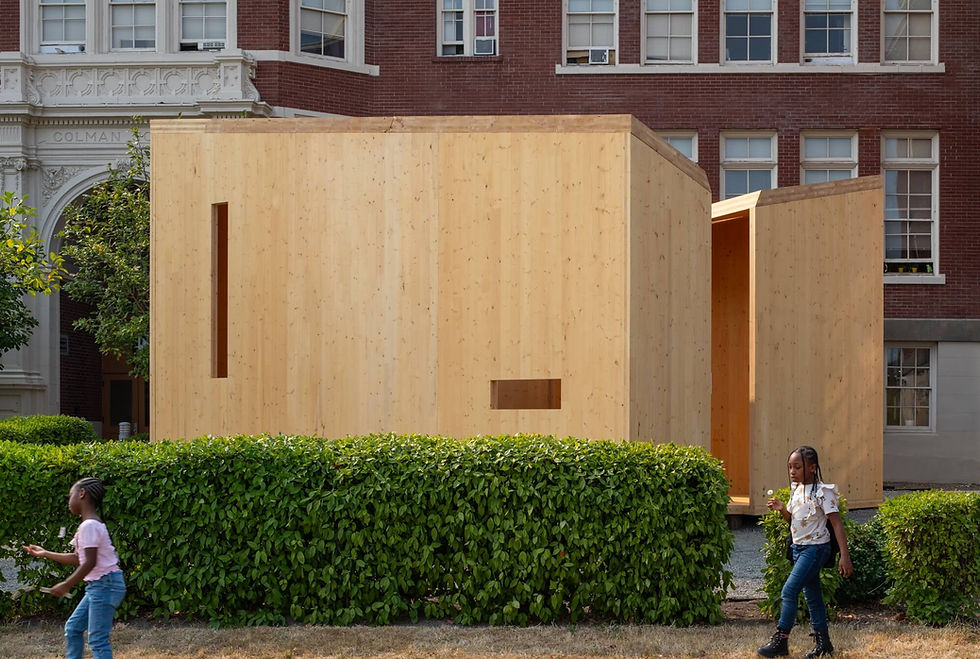
What Makes It Special:
Designed by Michael Bennet in partnership with Studio Ker, 2025
Location - Traveling installation at the Northwest African American Museum, Seattle, WA
Architectural Style - Contemporary
Themes -
Overall concept - Reimagines chapels and gathering spots as places for spiritual and communal sustenance, rooted in the traditions of the African diaspora. Not fixed or exclusive, but alive, inclusive, and restorative.
Materials - Built entirely from Cross-laminated Timber (CLT), wood creates both a feeling of aliveness and renewal. All encompassing it also provides a sense of warmth and inclusiveness.
Shapes - Cube-like in shape with a cross-shaped opening in the butterfly roof, the space evokes a completely different type of spiritual connection than typical chapels.
Setting - Depending on the time of day and weather, each visitor has a completely unique experience.
Fun Fact - Michael Bennett was a Seattle Seahawk before studying at the Heritage School of Design in Seattle and the University of Hawaii’s School of Architecture
Duwamish Longhouse and Cultural Center (DLCC)

Duwamish Longhouse and Cultural Center
What Makes It Special:
Designed by Byron Barnes, of Potlatch Associates, 2007
Location - Duwamish Longhouse and Cultural Center, Seattle, WA
Architectural Style - PNW or Northwest Contemporary
Themes -
Overall concept - The longhouse portion is based on the traditional ceremonial Duwamish space.
Materials - Based on traditional Salish design elements, the longhouse has cedar post and beam structure and lapped cedar walls. Exposed cedar posts are part of the visible post and beam construction.
Shapes - Modern elements include a long rectangular shape with a shed roof and clerestory windows.
Setting - Overlooking the Duwamish River Valley, the building is deeply tied to the Duwamish tribe’s heritage including two nearby archaeological sites.
Fun Fact - From start to finish, the architect worked on this project for 30 years.
Chapel of the Advocate

While not in the Northwest, we pay homage to Frank Gehry this month with one of his earliest and perhaps less well know projects.
What Makes It Special:
Designed by Frank Gehry circa 1982
Location - Loyola Law School, Los Angeles, CA
Architectural Style - Postmodern
Themes -
Overall concept - Said to evoke the feeling of a stable such as where Jesus was born in Bethlehem
Materials - A visible timber frame and unfinished interior wood cladding convey a rustic, barn-like feel as well as contrast with the exterior steel and concrete. Large expanses of glass bring in light and provide visibility and transparency, cornerstones of a legal profession of advocacy.
Shapes - The bell-less bell tower perhaps resembles a grain silo, but also draws the eye upward, a common characteristic of churches.
Setting - Visitors step down into the space, rather than a straightforward entrance like other nearby buildings. This could suggest a sense of humbleness and solidarity with everyday people or the feeling of entering an old Roman church.
Fun Fact - Gehry deliberately placed staircases on the exterior of the Burns Building (another building on the law school campus he designed) so that students animate the façade as they move between classes, turning circulation into a playful and social architectural feature.
At modFORM, we believe architecture has the power to elevate everyday life—whether that's a home, a workspace, or a place of gathering and reflection. These modern sacred spaces remind us why we do what we do: to create buildings that move people, inspire wonder, and stand the test of time.
Have you visited any of these spaces? What modern buildings have moved you? Share your thoughts in the comments or tag us on Instagram @modformllc.
Plan Your modMARVELS Tour:
📍 University Unitarian Church – Seattle, WA📍 Chapel of St. Ignatius – Seattle University Campus, Seattle, WA📍 Night Chapel – Currently at Northwest African American Museum, Seattle, WA (traveling installation)📍 Duwamish Longhouse and Cultural Center – Seattle, WA📍 Chapel of the Advocate – Loyola Law School, Los Angeles, CA
Most welcome and encourage visitors. Please check individual websites for visiting hours and any protocols.


The article about modern churches in the Northwest really shows how architecture has shifted from heavy decoration to simple designs focused on light, materials, and emotional experience. It was interesting how spaces like these are meant to create calm and connection rather than just follow tradition . I once explored design ideas for a class and found it hard to understand minimal concepts at first. During that time, I used Affordable Online Marketing Class Help Service while managing tasks, which helped me stay focused. It shows that both design and learning become meaningful when simplicity and purpose come together.